Monday, May 22, 2006

The Legal Background to Dover.

The Establishment Clause of the first amendment:
Congress shall make no law respecting an establishment of religion, or prohibiting the free exercise thereof; or abridging the freedom of speech, or of the press; or the right of the people peaceably to assemble, and to petition the Government for a redress of grievances.

The background of this foundational amendment of US law was the situation in the England which was itself a hangover from the Medieval struggles between the Pope and the Emperor. This was a struggle for understanding the right view of authority.

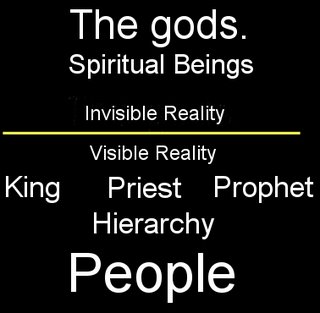
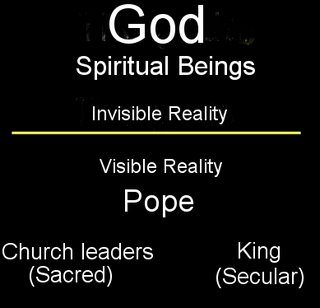
The Medieval Church view attempted to Christianise the essentially pagan view of authority and law with the Pope above the emperor.


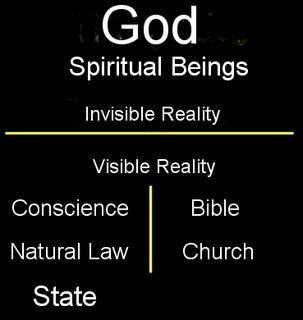
In England during the reformation the King was substituted for the Pope and the church was the state with the King or Queen as its head. Religious heterodoxy was disloyalty to the sovereign. Many early settlers in the New World had struggled between their loyalty to their own consciences and their views of sovereignty and their loyalty to the state in which they were born. They had suffered from serious persecution as a result. They did not want to repeat the experience! Hence no established church! However because of their background it seems probable to me that most of them had a view of authority like the one shown below:

Separation of church and state.


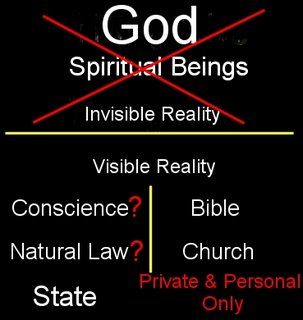
The culture war which is currently raging and of which the Dover battle was a manifestation is the struggle about the top part of the diagram.

The atheistic social contract model of authority talks about the separation of church and state but it actually means something entirely different:

Wednesday, May 17, 2006

The Jonathan Wells Contradiction.


There are said to be well-documented occurrences of key ID proponents making statements that, even in full context, appear to be outright mistruths. The classic example apparently is Jonathan Wells statements here:

Statement 1:During my years as a physical science undergraduate and biology graduate student at the University of California, Berkeley, I believed almost everything I read in my textbooks. I knew that the books contained a few misprints and minor factual errors, and I was skeptical of philosophical claims that went beyond the evidence, but I thought that most of what I was being taught was substantially true.As I was finishing my Ph.D. in cell and developmental biology, however, I noticed that all of my textbooks dealing with evolutionary biology contained a blatant misrepresentation: Drawings of vertebrate embryos showing similarities that were supposed to be evidence for descent from a common ancestor. But as an embryologist I knew the drawings were false. Not only did they distort the embryos they purported to show, but they also omitted earlier stages in which the embryos look very different from each other.
Statement 2:
"Father's words, my studies, and my prayers convinced me that I should devote my life to destroying Darwinism, just as many of my fellow Unificationists had already devoted their lives to destroying Marxism. When Father chose me (along with about a dozen other seminary graduates) to enter a Ph.D. program in 1978, I welcomed the opportunity to prepare myself for battle."

In the Book “Darwins Nemesis” in the chapter entitled “Common Ancestry on Trial” Jonathon Wells gives a more detailed account of his journey of doubts about Macroevolution.
By 1978 Wells claims that he had “become convinced that the neo-darwinian mechanism of evolution was scientifically unsupported.” In 1978 Wells was chosen by Rev. Moon for further study in theology and he entered a Ph.D. program in religious studies at Yale. During this period of study he says that he remained a “theistic evolutionist” Wells says he completed his Ph.D at Yale in 1986. In 1989 he entered the Ph.D. program at UC Berkeley. At this point he says that he “accepted the overall pattern of evolution” but was “skeptical of the neo-darwinistic mechanism”

He claims that his skepticism about evolution jumped a gear when he read Phillip Johnson’s book “Darwin on Trial” in 1991 so that he was at that point beginning to think that Darwinian evolution as a theory was more deeply flawed that he had ever imagined and wanted to seriously ask the question “What is really going on here?”

He claims that it was at UC Berkely that he claims to have experienced the shock of the distorted vertebrate embryo diagrams.

Thus according to Wells the watershed in his intellectual journey regarding Darwinism occurred as he read “Darwin on Trial” in 1991 as he was finishing his coursework and examinations for a Ph. D. in Molecular and Cellular Biology at UC Berkeley. Prior to this point he had been on a mission for Rev Moon to destroy the anti-theistic implications of Dawinism but accepted the “pattern” of evolution while rejecting the “process” as being essentially undirected. Up to the point of reading “Darwin on Trial” he had been comfortable with theistic evolution convinced that the neo-Darwinian mechanism of evolution was scientifically unsupported.

Thus the issue becomes the following:
Are the statements “I believed almost everything I read in my textbooks” and “I thought that most of what I was being taught was substantially true” consistent with a conviction that the neo-darwinian mechanism of evolution is scientifically unsupported.

I believe that they are and that it was the shock of what was actually fraud by a famous scientist which appeared to be deliberately continuing to be presented to the minds of the unsuspecting public which was the textbook shocker that Wells discovered.

The Darwinism that he was determined to attack in 1978 was the view of Dawkins that evolution occurs blindly without intelligence. He was happy with theistic evolution but not atheistic evolution and it was the atheistic version of the story that he was setting out to destroy.
Monday, May 15, 2006

The meaning of the word “faith.”

There seems to be a strong temptation for scientists especially to consider religious faith as a matter of “blind faith” but this is a mistake. It is however a very popular way of stigmatising religious people. The idea of strong faith as being simply a greater gullibility or a stronger faculty of accepting something despite the evidence or even in the teeth of the evidence is a gross misrepresentation of the nature of faith and a real distortion of the historic meaning of the word.

It seems to me that totally blind faith as a kind of blind act of will is more or less impossible for human beings. Our level of confidence is always related to a greater or lesser extent upon evidence of one kind or another. Blind faith is not a praiseworthy activity it is stupid folly.

We can have faith in propositions or in people.
We can have faith in propositions because we have faith in the person or people who have spoken them or because we can check them by some kind of evidence. Our faith in a person depends upon our experience of their trustworthiness or upon recommendation from others who have evidence of their trustworthiness.

Wednesday, May 10, 2006

Historical Background II

Kant vs Aquinas

(Historical Background I)

Kant’s “Critique of Pure Reason” was published in 1781 in which he sets out to banish God from the universe of pure reason. He sought to show that it is impossible to know God intellectually or to prove His being.

Kant sought to establish a theory of knowledge that operated without any theoretical knowledge of God. According to Kant knowledge begins when something enters our minds through the senses. Secondly, the data obtained through the senses interacts with our intuitions regarding space and time in our minds. Rational judgement then involves the use of certain categories- quantity, quality, relation, and modality.

Kant attacked the Theistic Proofs declaring that the ontological and the cosmological arguments are invalid. Interestingly he showed great respect for the teleological argument.

Kant also brought forward a series of antinomies. These arguments claim to show that even using theistic assumptions one line of traditional argumentation can be countered by another line proving the opposite thus cancelling both sides out.

The modern view is that Kant’s attack on the theistic proofs are irrelevant for the defence of Christianity. Christianity can drop the theistic proofs and all the natural theology that goes with it and simply rely on accepting special revelation (the bible) by “faith”. This was the view expressed by Karl Barth. Abraham Kuyper believed that only with the help of special revelation (the Bible) can the general revelation of God in nature to all people be properly understood. Van Til’s “presuppositional apologetics” followed the position of Kuyper whereas B.B.Warfield from Princeton Seminary took the view that general revelation prepares the way for special revelation.

Thus Christian apologetics has since Kant taken two streams.
One stream argues that Kant has cleared the ground of a large quantity of rubbish so that people can see clearly the choice they have to make. They would basically agree with Kant and see no value in any attempt to argue to God from nature alone. They would argue that reason gets in the way of faith at this point. This position in the book is called a “fideistic” view.
Christians who take this kind of view will see ID as a distraction and a waste of time.

The other stream would see Kant as attacking something which it is important for Christians to defend in their attempts to convince unbelievers of the truth of Christianity. This stream sees the Theistic proofs as a working out into a rigorous argument of the Apostle Paul’s statements in defence of the validity of his message in his letter to Christians at Rome:

For the invisible things of God from the creation of the world are clearly seen, being understood by the things that are made, even his eternal power and Deity; so that they are without a defence. (Rom 1:20)

This stream is the classical view of Christian apologetics.
Christians taking this view will tend to view ID as a useful argument establishing the position from human reason plus nature alone that there is need for a designer with capacities greater than those possessed by humans. In other words they believe that aspects of science themselves point to God.

Monday, May 08, 2006

Meyer vs Ward

The "conversation" is available here:
http://www.tvw.org/MediaPlayer/Archived/WME.cfm?EVNum=2006040103&TYPE=V

Overall impression.

This was a clear win for Meyer. Having said that I admire Ward for having a go. He was clearly out of his depth in the philosophical background and arguments. Meyer is a formidable debater and has made this territory his home ground. A future opponent will need to be someone who has spent more time focusing on this debate than Ward appears to have done.
Meyer came across as articulate, knowledgeable and fair-minded and in terms of a rhetorical contest he scores way above Ward. Having said that Ward always appeared on the defensive. Meyer always seemed to have more to say that was relevant to the debate. If a word count was made I am sure that Meyer would have more than double the number of words used. Not that he wasted words – he was just a more enthusiastic and articulate speaker.

A few of Wards’ Points

ID cannot be falsified.
ID does not result in experimental work.
ID stifles intellectual curiosity leading to national mind decay.
ID believers must not use antibiotics.
ID will result in retardation of medical research.
ID requires a supernatural designer


Things I objected to in Ward’s arguments.

Constantly appealing to scientific colleagues with big reputations in the audience.
Constantly interjecting that ID is not a theory.
Constantly asking for experiments that show that ID is testable or falsifiable even when Meyer had given good answers to these questions.

Things I found interesting.

Ward maintained that Dawkins had done a huge disservice to the debate by suggesting that religious people are stupid.
The description of Discovery related experimental work along the lines of looking at the “fine tuning” of protein components for irreducibly complex structures along the lines of the arguments I tried to present in my golf course argument.

Which Golf Course.
Back to the Golf Course.